Sessions Small Wonder Clearly Again Tabs
Every bit a guitar instructor, I've nerveless and created a lot of exercises over the years to assist my students. This guide will requite you lot an extensive list of guitar exercises you can practice to work on a range of different skills.
Each exercise volition include the exercise in Guitar TAB and Standard Annotation. I'll explicate each do in particular, why it's worth practicing and some extra tips to become the most out of them.
Notation: I'll be adding more than and more exercises to this guide over time, and so I recommend adding this page to your favorites/bookmarks and so yous tin can return to it in the futurity.
Whatever fourth dimension you want to piece of work on a unlike skill, come up back and you're likely to find an do that can help you.
How Guitar Finger Exercises Develop Your Skills
Recollect well-nigh a time yous have seen an advanced guitarist play something complicated, but they looked then relaxed playing it that they made information technology wait piece of cake. For a beginner or intermediate guitarist, information technology can be frustrating seeing somebody play complicated solos or riffs with ease.
Advanced guitarists can accomplish this level of skill thanks to muscle memory. "Muscle Retentivity" is what happens when you repeatedly make the same finger movements over and over. When yous exercise a riff over and over again a thousand times, your brain basically locks that riff into memory.
Eventually, you lot're able to play that riff on auto-pilot and non need to think virtually it at all. This is how advanced guitarists can master long and complicated solos. By practicing information technology over and over, they eventually lock those licks and phrases into muscle memory.
These guitar finger exercises are all designed to assist you develop different areas of muscle memory. Some of the exercises will give your fingers dexterity and independence. Some exercises will help you master techniques such equally bends, tapping, or legato.
Call back of each of these exercises equally a way to develop musculus memory for different skills and techniques.
Getting the most out of these exercises takes practice, only the good news is that these exercises can completely level-upwards your playing. When you start to acquire a new song, the work you've put in with these exercises will give you an advantage at mastering that song.
Regularly practicing these exercises will assistance yous learn songs faster, master complicated riffs or solos, and improve your confidence with the guitar.
How to Do These Exercises
Call back about each repetition you make of one of these exercises as a bicep ringlet. Imagine going to the gym, picking up a dumbbell, doing ane bicep curl, then going home. You lot wouldn't expect to see any muscle growth in your bicep subsequently that distressing workout.
Information technology's the same with these exercises. If you lot but play these exercises once or twice, it's like doing a bicep whorl and never picking up a weight again. You won't get anything out of it.
To actually become the well-nigh out of these exercises, you need to repeat them over and over, then practise them daily for at least a few weeks.
Important: the more you do these exercises, the stronger the muscle retentivity you will develop.
Many guitarists run through 5-10 of these exercises equally a warm-upward every time they sit down to practice guitar. Other guitarists dedicate 10-15 minutes purely working on these exercises in every practise session.
Whatever y'all practise, make sure you regularly practice these exercises and repeat them over and over. Build up your "reps" for each exercise in the aforementioned way a bodybuilder builds up reps for each exercise.
Don't but play each practise once, that'south like doing one rep on every machine in the gym. If you but play an practice in one case, you're wasting your time. Even if information technology feels easy the get-go fourth dimension you play it, spend fourth dimension with each exercise and truly master it.
Using a Metronome to Develop Each Practice
A metronome is a crucial practicing tool for well-nigh of these exercises. A metronome forces you to be verbal with the timing of each note y'all play. While there's nothing wrong with playing these exercises without a metronome, yous will go far more out of each do if you utilise a metronome.
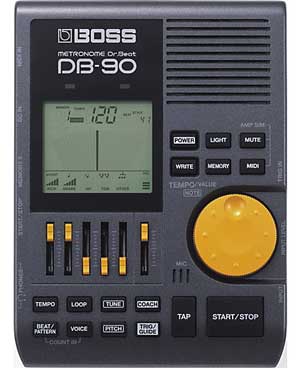
If you don't already have a metronome, you can download i of the many free metronome apps for your smartphone or tablet. If you want a physical metronome, there are plenty of options to choose from. Check out the Dominate DB-xc for an example of a feature-packed physical metronome:
There are two methods you can utilize when using a metronome with these exercises:
1. Build upwardly speed
With this method, nosotros perform the exercises along with a metronome and gradually increase the tempo over time. The goal is to gradually heighten the upper limit of what you're capable of playing.
Developing speed is easy if you take patience and do consistently. If you blitz, yous will sound sloppy.
The method is simple: start past playing the do forth with a comfy tempo. Let'southward say that tempo is 100 bpm. Play the practice at least 10 times along with that tempo and aim to perform the exercise perfectly 10 times in a row.
If you can effortlessly play the do ten times in a row without whatever mistakes, gradually increase the tempo (eg: 105 or 110 bpm). It should be such a small change in tempo that you don't actually notice the alter when y'all play.
Perform the exercise again at the higher tempo and count out 10 perfect repetitions. If you can practise it effortlessly, gently raise the tempo again (eg: 115 bpm). Do the practise over and over at the higher tempo and count out 10 perfect repetitions.
Yous proceed to gradually enhance the tempo until you start to struggle, mistakes start creeping in, or y'all experience like you're rushing or straining. Take note of the tempo when this starts to happen.
Let's say you beginning to notice pocket-sized mistakes while playing at 130 bpm. Y'all would take note of that tempo for your next practice session. 130 bpm is your electric current upper limit. Over time if you continue to practice you'll somewhen master this tempo and it will feel as effortless as 100 bpm feels.
The adjacent fourth dimension you practice, start the tempo as something comfy (eg: 115 bpm may be your starting point this fourth dimension), then repeat the process.
When you get to 130 bpm, you may notice it feels a little bit easier. If you can perform 10 perfect repetitions, gently raise the tempo to 135 bpm. Practice the do over and over and aim for x perfect repetitions. If you lot can't get ten perfect reps, don't increment the tempo. Leave it for the next day.
This might sound like a slow procedure, simply it only takes a couple of minutes per day. Eventually, you'll be playing the exercise flawlessly at 200+ bpm without breaking a sweat.
This method is incredibly powerful and it'due south how guitarists are able to perform such loftier speed and technical solos.
Why Speed Matters
Even if you don't have a goal of building up your speed, information technology's still worth using this method. Speed isn't just nearly being flashy or showing off – information technology's more than most command. If you can accurately play these exercises at a loftier tempo and stay in time, it means your fingers take mastered the do.
Guitarists who tin can perform these exercises at high tempos have more control over their technique than guitarists who tin't play at high tempos. And so even if yous don't want to be a fast role player, run into this as a style you tin better your command.
Imagine you lot had to perform a solo at 140 bpm. Past practicing the solo at 150 or 160+ bpm and mastering information technology at that tempo, imagine how effortless it will feel when y'all slow it back down to 140 bpm.
Information technology doesn't matter how long it takes you to build up your speed, it but matters that you piece of work on it. If it takes three months to build upward your skills, practice it anyhow. In 3 months' time, you'll be far meliorate off if you practise. Don't skip an exercise because information technology feels also difficult. Piece of work on it until it feels easy!
2. Slow it downward
The get-go method is the most mutual way of using a metronome because it's such an constructive way to improve your skills. Merely there'southward another way we can use a metronome and it's a method not many guitarists take reward of.
Playing something at a loftier tempo can exist challenging, but playing something at an incredibly low tempo tin be merely as challenging. Keeping perfect time tin can be hard at very low tempos as we're not used to boring things down and so much.
Examination Your Timing
A quick way to understand what I'm talking nigh is to endeavor and handclapping along with a metronome set to 20 bpm.
Set your metronome (you can download a free metronome app for your smartphone if you don't already have 1) to 20 bpm, close your eyes, and so endeavour to clap along with the beat.
Your goal is for every handclapping to perfectly line up with the clicking of the metronome.
Unless you've spent a lot of time practicing this, you'll find that it becomes extremely hard to try and perfectly fourth dimension when the next click will be. Most guitarists (even some advanced guitarists) will find this frustratingly hard to do.
Text
Now imagine instead of doing something as simple as clapping, you practice the aforementioned thing with a riff or solo. Imagine slowing a vocal downwards to 20 bpm and trying to proceed perfect timing. It's a lot harder than near people call back!
The purpose of this type of practice is to assist you dial in your playing and really chief every notation. By slowing it down so much, you have plenty of fourth dimension to think about every annotation. You lot're able to think most how long each note should go for, which finger to apply, how to precisely motion to the next note, etc.
If y'all've ever learned a riff or solo simply it didn't sound quite correct when compared to the original song, practicing using this method is a keen mode to notice out what needs to change.
For each of the exercises in this guide, try to play it every bit wearisome as possible while keeping steady timing. It's a great fashion to learn the exercises and work on your timing skills at the same time.
For most guitarists, I recommend spending 70% of your time working on the first method (building up speed) and 30% of your time working on slowing things down.
Finger Dexterity and Independence Exercises
Think of these exercises as the building blocks for your guitar skills. Being able to independently motility your fingers freely across the fretboard is crucial for accuracy and speed.
These exercises are designed to build up musculus memory in your fingers so you can motility beyond the fretboard without whatever awkward feelings or pressing down with the wrong fingers. Some of these exercises are like natural language-twisters for your fingers.
You have probably seen many of these exercises from different guitarist interviews and in guitar magazines. They're so mutual because they can have a massive impact on your playing skills.
Many avant-garde guitarists regularly use these exercises equally warm-ups before performing alive. Joe Satriani is known to play many of these to warm his fingers upwardly earlier every show.
Even if these exercises feel like shooting fish in a barrel the beginning time y'all try them, you should still add together them to your practice routine.
Archetype 1234 Do
The chances are you lot've seen this practise earlier and at that place's a expert reason why it'south so common. The '1234' practise is a great way to warm up your fingers, helps build picking and fretting control and is an insanely piece of cake exercise to build upward your speed.
If yous haven't already added this exercise to your practice routine, add together it now. Many guitarists use this exercise as their become-to warm-upwards before performing.
Here'due south the ascending version of the exercise:
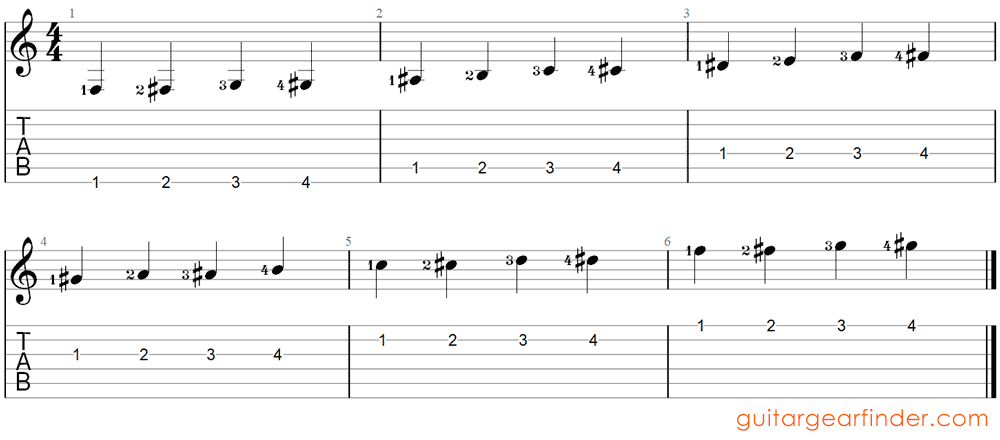
This do looks elementary, but it does wonders for your finger command. Beginners may even discover it an excellent way to stretch the fingers out.
The basic idea is that you utilise all iv fingers to play the four notes on each string. So yous use your first finger (index) to play the kickoff fret note, your second finger (heart) to play the 2nd fret annotation, third finger (ring) to play the tertiary fret note, and your fourth finger (pinky) to play the 4th fret annotation.
Of import:equally you lot play the notes, it is crucial that you continue to hold your fingers down. By the fourth annotation, y'all should accept all four fingers held downwards against the string.
This is important because it forces your paw to stretch out. If you were to lift your fingers off after playing each note, y'all'll develop bad habits and you won't stretch your hand out. Take a expect at any advanced guitarist play fast legato runs and you'll notice how closely they hold their fingers in position against the strings. This exercise helps build that addiction.
As a guitar teacher, I oft come across this when students accept trouble stretching. Instead of trying to stretch the fingers out, they 'cheat' by lifting their fingers off of the fretboard. Keep your fingers pressed against the string as yous movement to the next annotation.
If you have trouble stretching your fingers out over the get-go four frets, you can shift this practise upwardly the fretboard. Showtime with your first finger on the 7th fret. This turns the 1-2-3-four do into 7-eight-9-10. You'll discover it much easier to position your fingers the college upwardly the fretboard yous move.
Over fourth dimension, you can gradually piece of work your way down the fretboard until you accomplish the ane-two-3-4 position.
Picking patterns
I recommend practicing this exercise near of the fourth dimension using alternate picking. This means play down-up-downwards-up etc. Go along the downward-upward picking design across all strings. Every bit you build up your speed, yous'll discover this do much easier to perform with a good alternate picking technique.
Yous tin use other picking methods with this exercise (eg: all-down, all-upward, economy), just try to spend the most fourth dimension using alternate picking.
Using a metronome
This exercise is a perfect example of how a metronome can be useful in developing your skill and speed. Many advanced guitarists apply this exercise to build up their speed.
To play this exercise along with a metronome, you simply need to play one note per metronome click. Start at a slow tempo (eg: 60 bpm). If it feels piece of cake to play inperfect time, gradually heighten the tempo. As explained earlier, gradually heighten the tempo until you start to slip with your timing or you commencement making mistakes.
Over time you'll be able to raise the tempo to 200 bpm and beyond. All it takes is consistent practice.
1234 Exercise Variations
The classic 1234 exercise is a great starting point for developing your finger control. Simply it doesn't accept long to get comfortable with the pattern information technology uses. Fortunately, it's like shooting fish in a barrel to take the exercise and apply a different finger design.
Using unlike patterns will help you develop finger independence and dexterity. Learning how to smoothly movement from your fourth to your 2d finger without your other two fingers flailing in the air takes some fourth dimension to develop.
Hither is an example of a variation of the uncomplicated 1234 exercise:
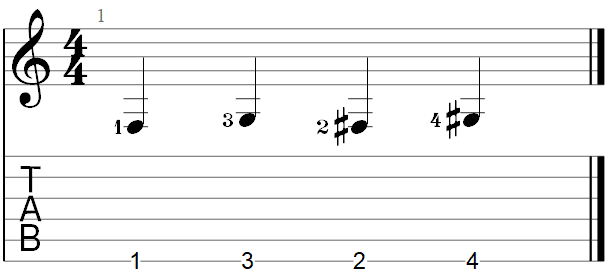
All y'all need to do is change the order of the notes you play. But like the 1234 exercise, play this pattern across all six strings.
Here is a dissimilar variation:
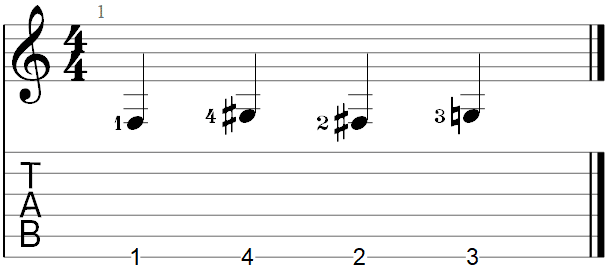
After you try these variations, try to come with as many different variations as possible (eg: 4123, 2431, etc.). The idea is that each variation gives you practiced exercise at different finger combinations.
Every fourth dimension you practice a new combination, you're training your fingers to motion independently from each other. With consequent exercise, it doesn't take long before your fingers feel confident with any combination.
Tip: If you find that y'all struggle with a certain finger combination, spend more time working on that combination. Work on it until it stops being a weak area of your playing. That manner if the combination shows upwards in a vocal, y'all're not going to struggle with it.
1234 Descending Exercise
All of the above exercises focus on ascending beyond the six strings. It's of import to practice any practice beyond all six strings then you feel comfy in any position. It's likewise important to practice this exercise going backward.
If you're a beginner or intermediate guitarist, you'll discover ascending far easier than descending. There's something nearly moving backward across the strings that slow guitarists downward slightly.
If you find it harder to play this exercise descending, spend time on information technology until it feels just equally easy as the ascending exercise.
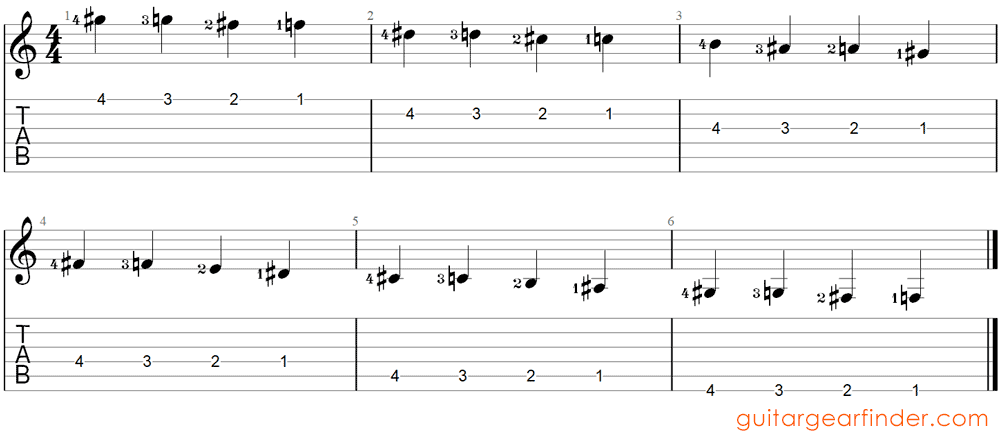
This time you start with all 4 fingers pressed against the cord in position. Line all 4 fingers upward along each fret and then all y'all need to do is gradually remove one at a time as y'all play.
When y'all move to the next string, place all four fingers into position before you play the kickoff note. This will slow you down at get-go, but it volition eventually experience then natural that you don't discover you're doing it.
Use alternating picking and focus on keeping perfect timing along with a metronome. Make certain every single note rings out clearly. If there is any fret buzzing or muted notes, stop and repeat the string.
Don't rush through the strings thinking yous're making progress. Play the exercise every bit irksome as you demand to play it perfect. If information technology'due south not perfect, slow down and fix your mistakes.
Descending variations
Just like earlier, you can use any variations you want from this 4321 descending pattern. You lot can even use the same patterns you lot came up with for the ascending pattern (eg: 1234, 1324, etc.).
Endeavor to find the patterns that crusade you the most discomfort and work on them until they experience like shooting fish in a barrel. The goal here is to become completely competent with any variation.
Broad Stretching Practice
If the classic 1234 exercise didn't feel similar information technology stretched your fingers out at all, this exercise volition do the chore. Even some advanced guitarists may struggle with this one and then be careful and don't strain your fingers.
If this exercise seems impossible, just shift it up the fretboard into a more than comfortable position. Over time you can gradually shift dorsum down until you lot're able to stretch out in the lowest position without any issues.
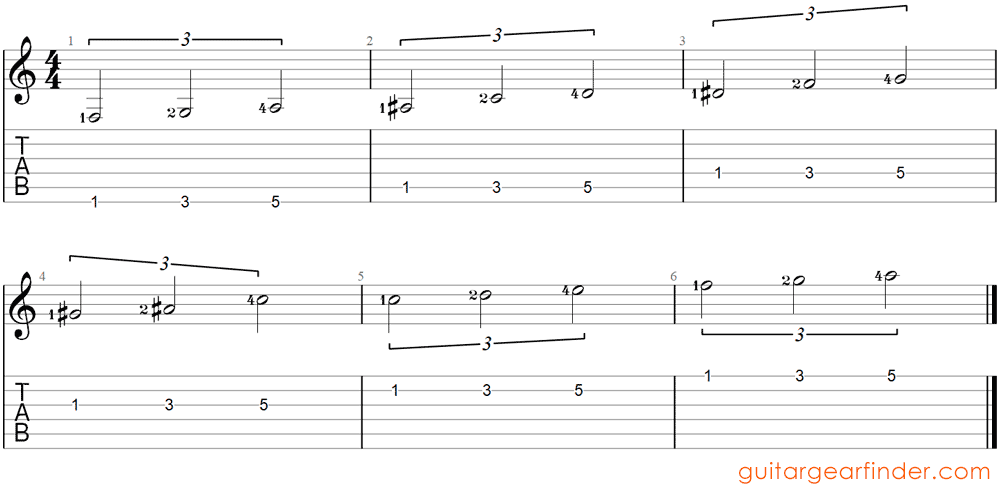
With this exercise, we're playing 3 notes per cord. Just like the 1234 exercise, the idea hither is that yous agree down each finger as you lot play. So by the terminate of the bar, you lot should have three fingers held down into position.
If you oasis't tried this exercise before, you'll definitely feel your fingers stretch every bit you reach for the fifth fret. Brand sure you continue to hold your offset finger into position against the showtime fret. This exercise doesn't piece of work if y'all lift your first finger or yous let it slide across the string.
In the to a higher place practice, the finger numbers are labeled 1, ii, and iv (notice the numbers next to the notation symbols on the staff). This means you play the first fret with your showtime finger (index), the third fret with your 2nd finger (middle), and the fifth fret with your fourth finger (pinky).
Some guitarists may observe this as well hard when they use their second finger on the third fret. If you struggle with this design, try using your third finger instead on the third fret.
Important: at no indicate should you feel hurting in your fingers or hand when playing this practice. If y'all feel pain, it means y'all're trying to stretch too far for what your fingers are ready for.
Just similar you shouldn't try to over-stretch before exercising or playing sport, don't over-stretch during guitar finger exercises. If this do hurts in any way, shift it upwardly the fretboard to a more comfortable position.
Kickoff at the 7th fret and then the practice becomes vii-9-xi instead of 1-3-v. If that still feels besides hard, motion up higher. If it feels easy, move downward. Gradually piece of work your way down to the everyman position, just don't force yourself. Be patient.
It's fine if you feel some slight discomfort in your fingers, but there should never be hurting.
Feel complimentary to use any picking pattern you desire for this exercise. Experiment with strict alternate picking, economy picking, all-downward, all-upwards, and anything else yous want.
Wide Stretching Variations
Just like the classic 1234 exercise, we can easily come with different patterns for this practise that stretches your fingers in different means.
The important stretch is from ane-5, so as long every bit you go on those two notes, yous can play around with anything in between.
Hither is a great variation worth practicing:
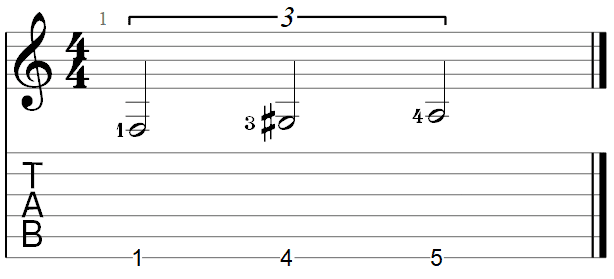
The reason this is a nifty stretching exercise is that information technology works your third and fourth fingers. Many guitarists will struggle with this pattern, so if you lot have trouble with information technology, shift the practice up the fretboard and gradually piece of work your style down once more.
Hither is another variation:
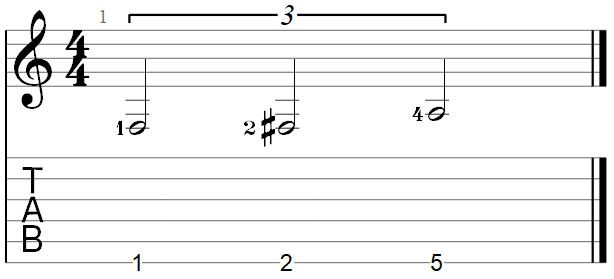
This variation focuses on stretching between your 2nd and fourth fingers. Recall to focus on any variation that you lot find challenging. And so if yous find this variation difficult, spend time with it until it feels easy.
Chord Finger Exercises
All of the in a higher place exercises focus on developing your finger independence and dexterity for playing scales, riffs, and licks. They're sequential exercises which means they focus on how your fingers move from one note to another.
When we play chords, sequential exercises won't aid u.s.a. considering we need to move all of our fingers at once. This takes a different kind of skill and a unlike kind of practise to develop.
The beneath exercises are designed to assistance you develop your finger control when moving betwixt chords. If you accept trouble moving quickly into chord shapes accurately, or your chord changes are boring, add these exercises to your practice routine.
Chord Flipping Practice
The idea behind this exercise is elementary: line upwardly your fingers in a 1-2-three-4 blueprint across the bottom 4 strings. Play these notes as a chord then flip the pattern to iv-3-2-1. Continue to flip back and forth between the two chord shapes focusing on accurateness and speed.
Here is the exercise:
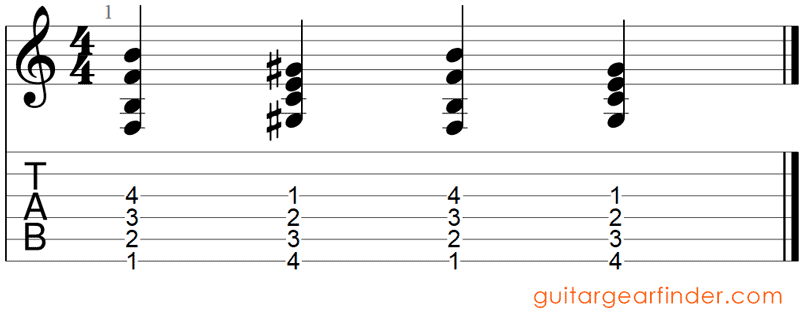
While this practice sounds terrible due to the weird chord shapes, information technology does wonders for your musculus memory.
The diagonal shape your fingers make against the fretboard makes this an easy practise to check if you lot're lining your fingers up properly. You should instantly discover if a finger is out of position before you strum the chord.
The goal is to be able to place all four fingers into position at the same exact time. Beginners are probable to start by placing one finger downward at a time. Learning to place all fingers down into a chord shape at the same time dramatically speeds upwardly your chord changes.
One time you feel comfortable with the 2 chord shapes, use a metronome to strength yourself to stick to a strict rhythm. Gradually build up the tempo until yous're accurately flipping between the two shapes at a rapid pace.
Extra tip: if you have trouble stretching your fingers out to attain all of these notes, shift the entire chord shape higher up the fretboard. Simply like the 1234 practise from before, shifting the exercise up the fretboard is an piece of cake way to feel comfy before you lot attempt to work back down and stretch your fingers out.
Avant-garde Chord Flipping Exercise
The in a higher place exercise becomes easy afterwards a while due to the simple fashion the fingers move back and along between chord shapes. All 4 fingers motion in the aforementioned direction, which is easy to figure out every bit yous play.
This exercise complicates things past making your fingers move in different directions. This works wonders on your finger independence and dexterity.
If you have trouble with the in a higher place do, proceed working on it earlier you lot try this one out.
Here's the exercise:
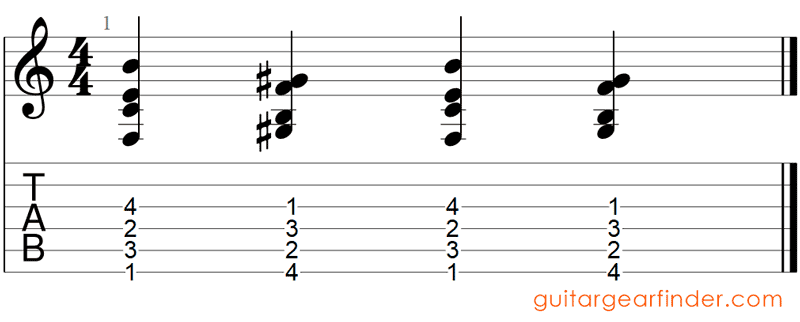
As you can run into, the exercise uses the aforementioned bones thought every bit the previous i, but the chord shapes are slightly dissimilar.
This time your fingers don't make a nice diagonal line across the strings. The center two notes are flipped. When you change to the 2nd chord shape, you'll detect that the middle two fingers motility in the opposite direction compared to the start and 4th fingers.
Beginners will find this extremely challenging. Even intermediate guitarists tin get tripped up by these chord shapes – especially if you lot're not used to moving all of your fingers at once into chord shapes.
Concentrate on the positions you need to move your fingers into earlier yous start to move. Visualize in your caput what the chord should wait like. It might audio strange to do, but it helps you figure out what to practice.
Accuracy is crucial to this practice. There's no benefit in playing this exercise fast if y'all're not authentic with the chord shapes. Focus on accuracy earlier you try to speed the metronome up.
If you struggle to move all four fingers into position at the same time, stop the metronome and work on it as deadening as you need to until you can get it right. Don't permit yourself 'cheat' by moving ane finger into position at a time. All iv need to movement at the same time for yous to get the most out of this exercise.
Notation: more exercises will be added to this list over the next few weeks. Bookmark/Favourite this page to come back to information technology and work on new exercises. Subscribe for e-mail updates for more than lessons, guides and gear reviews.
Related Guides and Lessons:
Source: https://guitargearfinder.com/lessons/ultimate-list-of-guitar-finger-exercises-with-tab/
0 Response to "Sessions Small Wonder Clearly Again Tabs"
Post a Comment